
"Becoming Painting and the Power of the Image: Contemplation, Evocation, Vertigo, Serenity"
BY Fernando Rojo Betancur
January 2, 2026
The art of young emerging artists today possesses that freshness of quixotism, of contemplating reverie and that interstice between sleep and wakefulness, between the imaginary and the real, in an alchemy or crucible of styles and movements such as expressionism, new figuration, abstraction (lyrical and geometric), surrealism, action painting, and gestural painting and drawing. In this way, a plastic language is configured that freely brings together these languages through novel media and supports within the universe of new technologies (in a digital world of excess and saturation of images and iconographies).
After the decline of the avant-gardes, modern art, and the plastic developments of postmodernity, artists face the challenge of reinventing art, even if it seems utopian, by applying and reinterpreting aesthetic and semantic forces. This is possible because they possess the historical baggage of images in retrospect, with full access to the past or the tradition of painting through information contained in books, publications, or encyclopedias. Additionally, they can reread the history and historiography of art or its aesthetics not only in museums, galleries, or collections, but also through the Internet, platforms, and mass media in the era of the Digital Revolution. All of this gradually condenses into their visual culture.
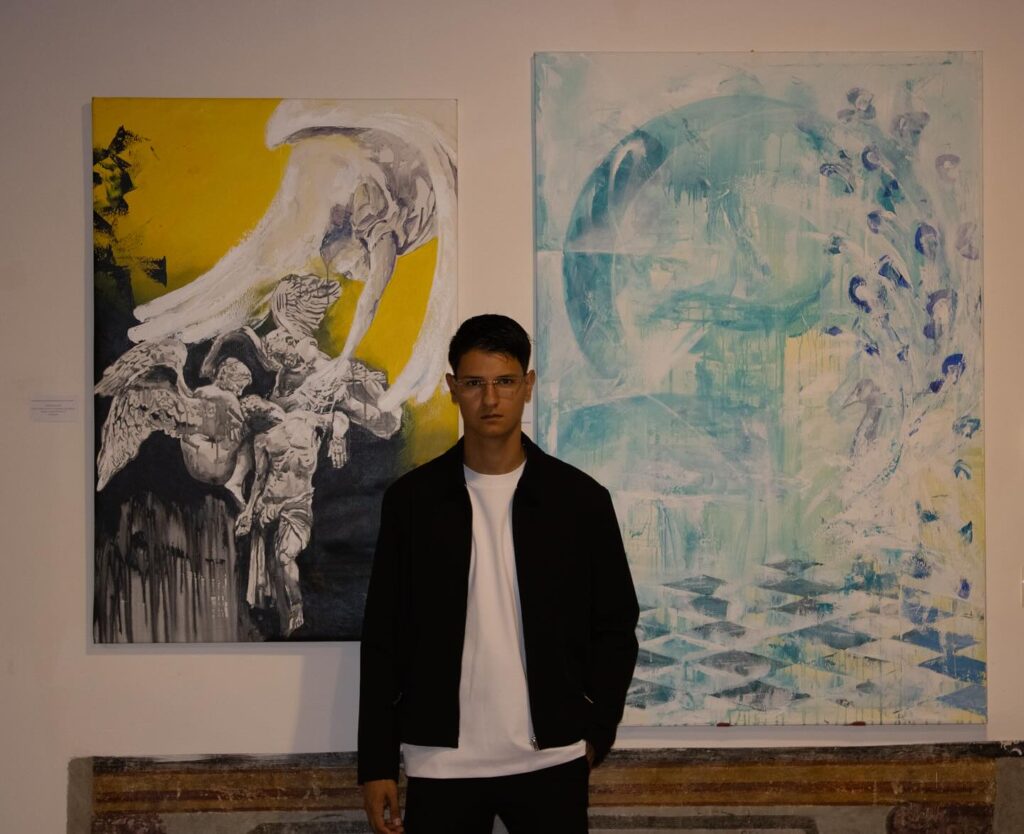
The work of Tomás Salazar presents this speculation about the human condition, in contrast with vital experiences, the metaphysical, and the transcendent. It is also nourished by academia and experimentation, freedom, innovation, and expressiveness. One must not forget that his generation is televisual, having grown up under the influence and impact of cinema, design, advertising, literature, television, and the rise of the Internet. All of these elements give rise to eclectic visual styles, and within this context another possibility also emerges: the difficulty or risk of labeling an artist who can be chameleonic and dedicate himself to simultaneously exploring, or within his processes, many expressive media or genres of contemporary art, such as performance, installation, gestural painting, expanded drawing, video art, etc. However, Tomás, beyond fashions or trends, continues to commit to painting as a medium and communicative support, without ceasing to confront reality and his own inner world—neo-baroque, dramatic, emotional, fragmented, rich, and suggestive. His commitment to art denotes and connotes an ontological search, an existential substratum.
Tomás does not abandon the rigor of an almost ascetic vision of painting, nor the commitment to the painter’s craft, to constancy and discipline in drawing and pictorial gesture, nurtured day by day through practice, laboratory work, and academic or personal experimentation. Therefore, his plastic, pictorial, and artistic process is not youthful nihilism, nor an existential or idealistic rebellion without cause; it is a commitment to his identity as an artist, who deeply understands the power of enunciation of the image in contrast with the word.
Painting and illustration are polysemic, dynamic, expressive languages, with many semantic and communicative possibilities. They are languages that allow self-knowledge beyond mere creativity, virtuosity, innate talent, or mastery of purist or traditional artistic techniques. In his work there is control, awareness of what is being done, principles and vital forces, telluric forces, ontological charges, and substrata of the human and the transcendent.
Metaphor (based on resemblance) and metonymy (based on a relationship of contiguity: cause–effect / part–whole) in the image are rhetorical figures that also function as semantic resources, allowing the artist to go beyond the merely literal or mimetic figurative image. These figures present a network or layers of meaning that generate aesthetic or emotional effects in the viewer who observes the work and enters into dialogue with it.
The evolution of universal art history, particularly in painting, has taught us how the force and temperatures of color—which is a fundamental compositional and expressive element—or the force and power of forms operate as thermometers of human nature, which can be represented in decay and fragility or rising beyond its limits, being reborn or reinventing itself. The work of Tomás is the germ of a generous, sublime, romantic, idealistic, and contemplative essence. It attempts to contain the vastness of the human soul, the phenomena of the environment or reality, fantasy and imagination, as well as the passions or tensions that arise there. In painting there are diverse feelings; there is an emotion that is captured and transformed into gesture or image, for example, when one evokes the pictorial work of artists such as Mark Rothko, Jackson Pollock, Arshile Gorky, Willem de Kooning, Caspar David Friedrich, Edvard Munch, Vincent van Gogh, Roberto Matta, and, in the Colombian context, the Spanish-Colombian painter Alejandro Obregón and the Cali-born Pedro Alcántara Herrán.
In the painting of Tomás Salazar, symbolic forces, vigorous strokes, and formal expressions allow for plastic solutions that surpass iconographic conventions. From the aesthetic categories of art, it must be recognized that the artistic genre of painting resists disappearing; rather, we can say that it transforms. Pictorial matter continues to configure itself as a language in which reactions, masses, and energy are exchanged. Art is a form of knowledge, and painting does not exclude itself from these possibilities.
In current artistic configurations, the order of what is seen may be disrupted, subverted, deconstructed, or expressively destroyed in order to create a new alternative reality. Today, when confronting the reality that affects the painter, it is still possible to dissociate history and traditional, established image narratives, and to speculate extensively with the image through pictorial practice. We speak of post-photography, post-history, and we can also speak of post-painting when we observe, for example, the elucubrations or manifestations of expanded painting, or painting that, from informalism, has become almost a three-dimensional or sculptural object, with a highly dramatic poetic structure.
In contemporary art, and in the making of an easel painting on a stretcher, it frequently occurs that the processual aspect of painting prevails over form, over the piece conceived as a finished pictorial work. The artist engages in dialogue with materials, takes advantage of unforeseen events, interrogates pictorial matter, and projects himself into it.
In the aesthetics and iconography of Salazar’s painting, we move from contemplating calm and serenity to perceiving reflections of intense emotional and psychological experiences, where consciousness itself is deeply explored or passions are exalted, as well as the beautiful or the monstrous aspects of human nature. Personal mythologies manifest an inner freedom, the bold risk assumed in painting beyond academic or rhetorical conventions, thus making visible the individual subjectivity of the artist. We witness something akin to the vertigo of an abyssal existentialism, or the possibility of being absorbed by nature and its cosmic, untamed, or telluric forces. Those images that overwhelm us, that remain in memory and imagination, eliciting deep emotions or immersive experiences, are “awakened” through pictorial gesture, through the thick or expressive impasto of paint (depth, forced or angular perspectives, vibrant color contrasts, dynamic compositions that immerse us in the structuring of interior landscapes that emerge and reveal themselves as if in a primordial state or suspended animation, in pulsating or violent images that express a kind of nervous vibration or exacerbated breathing). Images become iconic signs that go beyond figuration, representational tendencies, or rhetoric; their meaning evokes a ghostly presence that remains in a mental map or space, a multidimensional interior landscape.
The artist amazes us and allows us to connect with him, with his inner world, with the immense, the mysterious, the enigmatic, melancholy, symbols, and archetypes—all elements that challenge our everyday perception. Tomás, in his painting, is a child, a poet, a thaumaturge, a sage who does not age, a ship’s captain or the ship itself sailing the sea, a mythical triton of unfathomable waters, an untamed bird scanning the land, a medieval knight or his runaway horse, an astronaut in outer space, an iridescent meteor of impetuous force.
In his work, Tomás Salazar does not completely abandon naturalism, realism, landscape, portraiture, or the representation of objects, as an inheritance of so many styles in art, whether from nineteenth-century, modern, or avant-garde art. However, the level of iconicity in his painting can vary, adapting to the painter’s intention, to his visual poetics and rhetoric, in order to achieve impactful images that transcend the obvious or the literal. His art problematizes reality through representation, leading to diverse meanings and different planes or levels of reality, within a continuous search for meaning.
The materiality of painting and conventional or traditional supports manifests itself through an autoreferential, autoethnographic narrative. In his iconography, Tomás produces expressive, denotative images, but he also connotes veiled themes and images of symbolic force, where the Renaissance or Euclidean perspective of representation can be deconstructed, as in Cubism, Cubist collage, or Constructivism.
In this case, Tomás—initially a studio artist—through sensory contact with nature and not only through the exploration of his own emotions, silently observes the natural environment, the vastness of the countryside, the sea, the sky, the land in the open air (reminding us more of nineteenth-century European Romantics than of the Impressionists), and ventures into the adventure of being an artist who develops perception outdoors, even through photography. Experimentation with materials and techniques in painting and sculpture is part of his premise of freedom, which balances the academic and the subjective; the power of the optical (the visual) and the haptic (touch), in harmony or consonance with memory.
The painter immerses us in the tactile nature of his dreams, involving us as witnesses to his microcosm. In his work, we can find anything from an austere economy of color in the palette to profuse baroque chromaticism that alludes to sensual enjoyment and the pleasure enabled by color, thereby resignifying concept, meaning, content, poetics, and form.
Images or representations of humans, animals, or objects are not always clear; they are also suggested, veiled, wrapped in chrysalises, cocoons, or glazes—“connected” to something or someone precisely through these veils, as well as through form and color. Something ritual occurs in the painting; bodies in their dramaturgy are linked or dissolved, leaving a physical or mental presence, a trace or imprint, a sign that remains, operating almost as an archaeology or detritus of memory, a metaphor between body and passions, between the rational and the irrational. Anachronistic stories of the past intertwine with intuitive images of the present.
The pictorial universe of Tomás manifests itself through mysterious forms, eclipsing or colliding stars, celestial bodies wrapped in pale glimmers, the germ of a mythical nature, of the foundational origin of lost paradises. It is also expressed through symbols that allude to elements such as love, eroticism, beauty, war, the tragic, victory and defeat, chance, play, life and death (the drives of eros and thanatos), honor, nobility, loyalty or disloyalty, the sinister, the ambiguous, the sweet, the bitter, fragility and strength. The artist makes visible the secret correspondences between these elements; the abstraction of all these concepts transforms them into organic elements, into metaphors of life that gravitate across diverse scenarios and affective dimensions.
The semantic value of the image lies in how the work is configured as a communicative system. In his paintings, violence or drama is softened or contrasted with the forceful and fragile beauty of objects and forms. There is a manifest creative vigor, a gradual and progressive refinement of these forms, where the tragic is tempered and sublimated by beauty.
Many of his paintings reveal the artist’s innate curiosity for observing everyday phenomena, leading to formal image solutions, whether through a parallel or contrast between abstraction and figuration presented simultaneously, or between the telluric and the ethereal, imagination and fantasy, the mythical and the magical. Chronos time, kairos time, and the atemporal intersect and are disrupted. Everything emerges from reflection, from probing his interior in contrast with reality, in order to become painting.

