
"Time in Iron: Tomas's Secret Listening"
BY RAFFAELLA SOLFANELLI
June 14, 2026
I met Tomas in November 2025 in Rome, during a group exhibition. I remember that moment perfectly: amidst so much visual noise, his paintings possessed a different vibration. I was completely captivated. There was an ancient maturity in his gestures, a talent so crystalline and undeniable that it seemed almost unbelievable for his young age. It was then that I understood I wasn’t in the presence of a mere executor, but rather a soul guided by an authentic, pure, uncontaminated creative urgency.
Today, seeing him debut in sculpture confirms that feeling. It’s the natural evolution of an artist who neither knows how nor wants to remain on the surface of the world, but needs to excavate, to confront the depths of matter.
Tomas doesn’t mold form: he courts it, challenges it, and ultimately, listens to it.
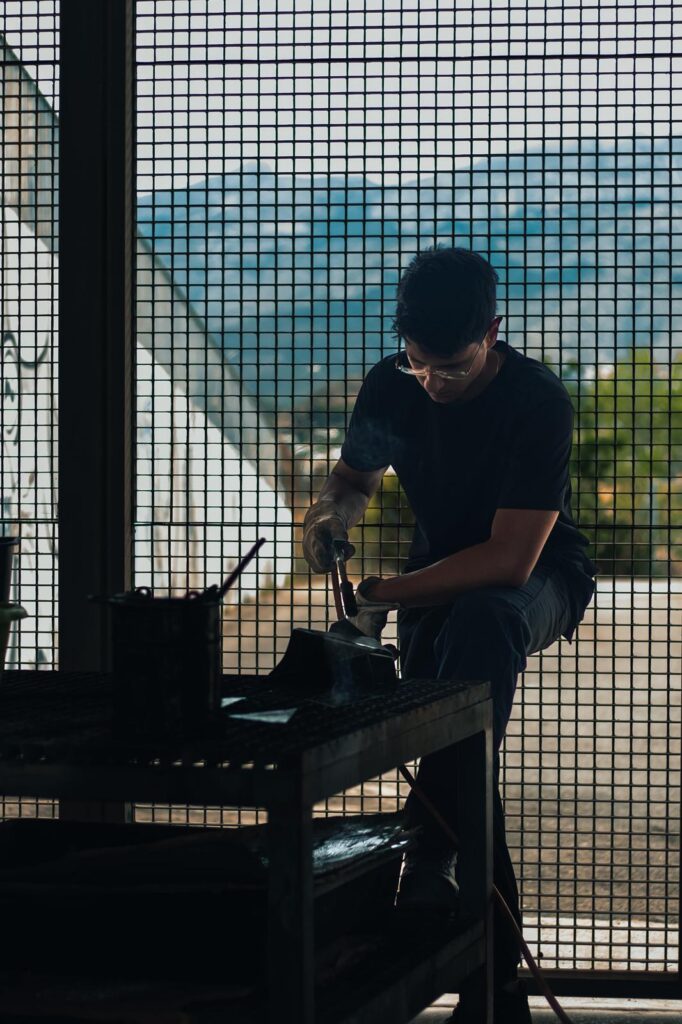
His journey begins with a flat, rigid, cold sheet of metal, charged with an internal tension and a resistance that seems to reject human intrusion. Thus begins a ritual of precise physical gestures: folding, welding, cutting, marking, filing, polishing. But there is no pretense of absolute control here. Tomas doesn’t impose his will on the iron as a potter would on clay or a sculptor extracting stone. His is, rather, a control of time. In this physical encounter with the metal, the artist enters a state of profound awareness, a meditative dimension where seconds dilate and the noise of the world fades away.
There is a precise instant in the process where the material ceases to be an adversary: “I always touch the material, but there comes a moment when I let myself be touched.” In this confession lies the beating heart of this exhibition. Rigidity gives way, coldness becomes confidence. It is the moment when the artist accepts being touched by the material, becoming vulnerable before it. Only when he begins to truly understand and listen to it does iron grant him the power to transform it, sending him invisible signals, whispering where to bend or where to draw a line.
Each piece on display is, therefore, a manifesto of geometric disobedience. Tomas’s process is not the submissive execution of a plan or a preliminary sketch; paper bears laws that living iron rejects. The moment the artist’s skin collides with the physical temperature and hostility of the metal, the original plan dissolves. It is a conscious renunciation of the dictatorship of the straight line. The work disowns its own model to surrender to sacred accident, to drifting and mutation, finding its true identity only when it deviates from the planned path.
The sculptures that inhabit this space are not closed objects; they are fragments of an intimate dialogue that continues to beat. They are the metallic diary of a young artist who has had the courage to relinquish control and allow himself to be guided by the secret voice of matter. An exhibition that not only invites us to look at the form, but demands that we, with our hearts, learn to listen.

